
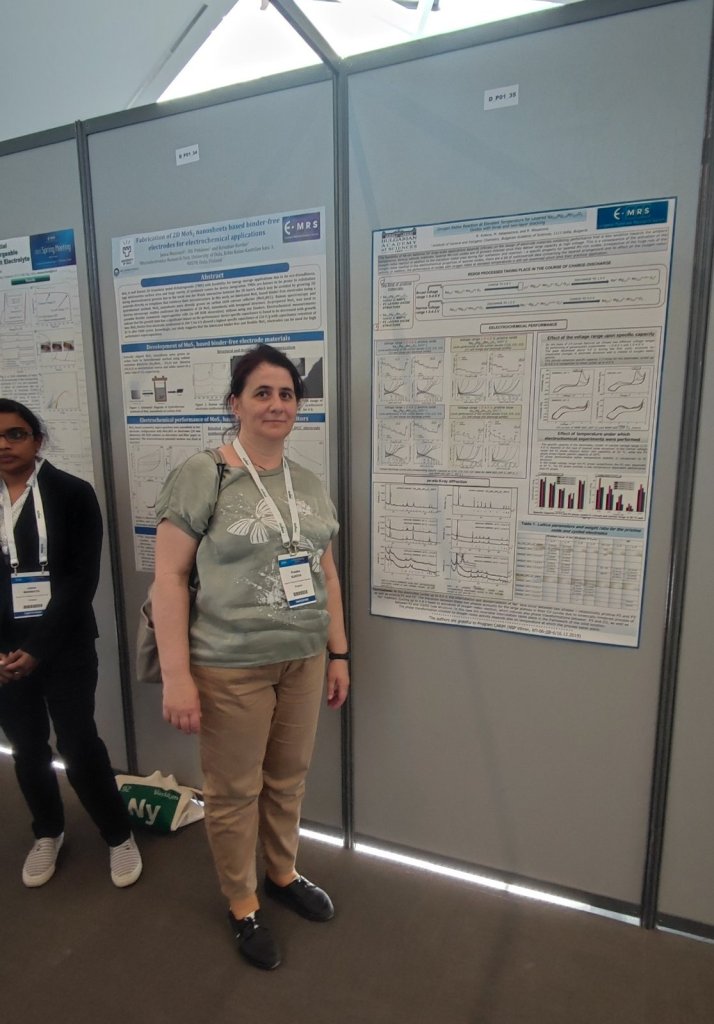
Oxygen Redox Reaction at Elevated Temperature for Layered Na2/3Mg1/3Mn2/3O2 Oxides with three and two-layer stacking
R. Kukeva, M. Kalapsazova, and R. Stoyanova
Abstract: The feasibility of Na-ion batteries for large-scale applications depends critically on the design of electrode materials exhibiting performance that is less sensitive towards the ambient temperature [1]. Among cathode materials, layered Mn-rich oxides are of primary interest since they deliver large capacity at high voltage [2]. This is a consequence of the activation of the oxygen redox reaction in addition to the transition metal ones during Na+ extraction and insertion – a specific property for layered Mn-rich oxides [3]. Irrespective of the huge role of the oxygen redox reaction in the electrochemical properties of layered oxides, there are a lot of controversial data concerning the layered arrangement and its effect on the oxygen redox activity. In addition, the performance of oxides with oxygen redox at elevated temperatures is still not examined which limit their practical application.
Herein, we examine the oxygen redox reaction at elevated temperature for the layered Na2/3Mg1/3Mn2/3O2 oxides having one and the same composition, but adopting P3- and P2-structural modifications. Layered Na2/3Mg1/3Mn2/3O2 oxides are prepared by freeze drying method, followed by thermal treatment between 600 and 800⁰C. At 600⁰C, oxide with a P3-type of structure is formed, which is transformed into a P2-type of structure at 800⁰C. The CV-curves of two modifications at 20 and 40⁰C allow to discriminate the dependence of the oxygen redox activity on both the type of layered stacking and the enhanced temperature. The cycling stability and rate capability of P3- and P2-oxides are examined in broad voltage range (i.e. from 1.5 to 4.8 V) in order to activate the oxygen redox activity. Based on post-mortem XRD and EPR analyses, the structure stability of cycled oxides and possible “electrode-electrolyte” interaction at elevated temperature were discussed.
The insight into the features of studied composites reveals the structural and chemical origin of oxygen redox properties. The knowledge on the oxygen redox at elevated temperatures would contribute to expand operational capabilities of oxygen active electrode materials.
Acknowledgements: The authors thank for the financial support of the project CARiM (NSP Vihren, КП-06-Д B-6).
The authors from CARiM’s Research Team are bolded.
 VIHREN-CARiM 2019