
Synergetic effect of bulk and surface modification of layered Na2/3Ni1/2Mn1/2O2 oxide for enhancing the electrochemical performance
M. Kalapsazova, E. Zhecheva, R. Stoyanova
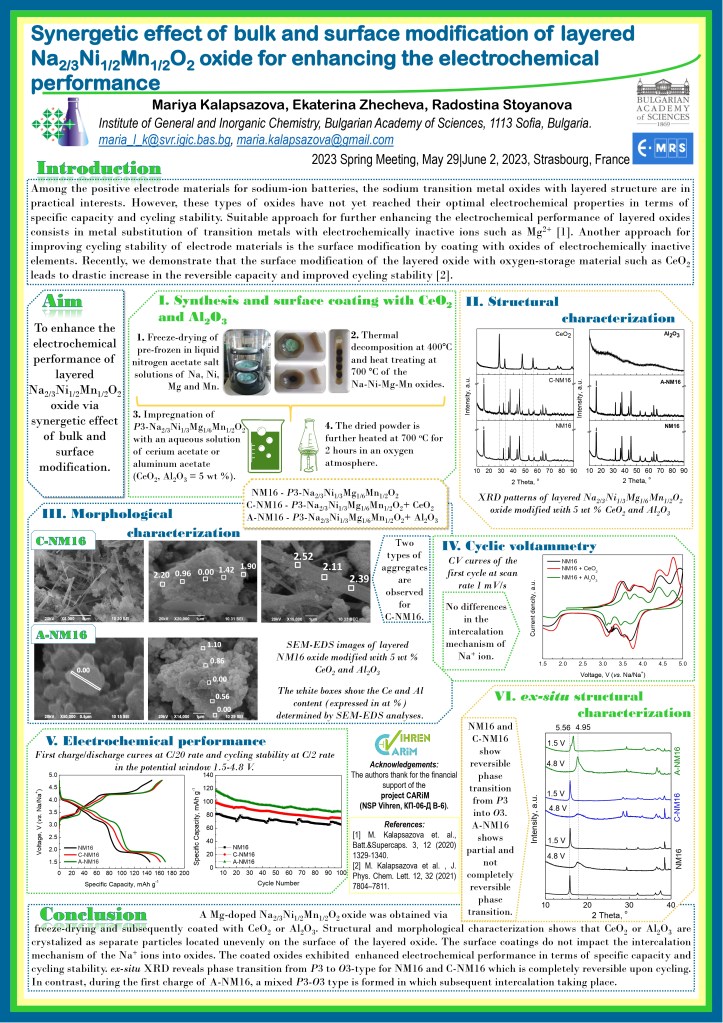
Abstract: Sodium-ion batteries are promising candidates for grid-scale energy storage due to sodium abundance and its low-cost, as well as the similarities in electrochemical performance to the lithium-ion batteries. Among the positive electrode materials for sodium-ion batteries, the sodium transition metal oxides with layered structure are in practical interests. However, these types of oxides have not yet reached their optimal electrochemical properties in terms of specific capacity and cycling stability. Suitable approach for further enhancing the electrochemical performance of layered oxides consists in metal substitution of transition metals with electrochemically inactive ions such as Mg2+ [1]. Another approach for improving cycling stability of electrode materials is the surface modification by coating with oxides of electrochemically inactive elements. Recently, we demonstrate that the surface modification of the layered oxide with oxygen-storage material such as CeO2 leads to drastic increase in the reversible capacity and improved cycling stability [2].
Herein we provide new data on the synergetic effect of both approaches – metal substitution in the structure and surface modification by coating. As metal substituents, Mg2+ ions were used. In the pristine Na2/3Ni1/2Mn1/2O2 oxide part of the low-oxidized nickel ions were replaced obtaining the desire composition of Na2/3Ni1/3Mg1/6Mn1/2O2 (NM16). Furthermore, the metal-substituted oxide is treated with electrochemically inactive oxides, such as CeO2 and Al2O3. It is found that the coatings do not affect the bulk of NM16. The results from SEM-EDS evidence an uneven distribution of coating oxides, CeO2 and Al2O3, on the surface of layered Na2/3Ni1/3Mg1/6Mn1/2O2 oxide. The electrochemical test is carried out in a broad potential range between 1.5 and 4.8 V. The coated oxides show improved electrochemical characteristics in terms of specific capacity and cycling stability in comparison with pristine Na2/3Ni1/2Mn1/2O2 and substituted Na2/3Ni1/3Mg1/6Mn1/2O2 oxides. An ex-situ XPS and EPR analyses reveals that the CeO2 and A2O3 modifier tunes the electrode–electrolyte interaction and prevent the cathode surface from hydrogen fluoride (HF) attack at upper potential limit.
References:
- M. Kalapsazova, P. Markov, K. Kostov, E. Zhecheva, D. Nihtianova and R. Stoyanova, Batt.&Supercaps. 3, 12 (2020) 1329-1340.
- M. Kalapsazova, K. Kostov, R. Kukeva, E. Zhecheva and R. Stoyanova, J. Phys. Chem. Lett. 12, 32 (2021) 7804–7811.
Acknowledgements: The authors thank for the financial support of the project CARiM (NSP Vihren, КП-06-Д B-6).
The authors from CARiM’s Research Team are bolded.
 VIHREN-CARiM 2019