

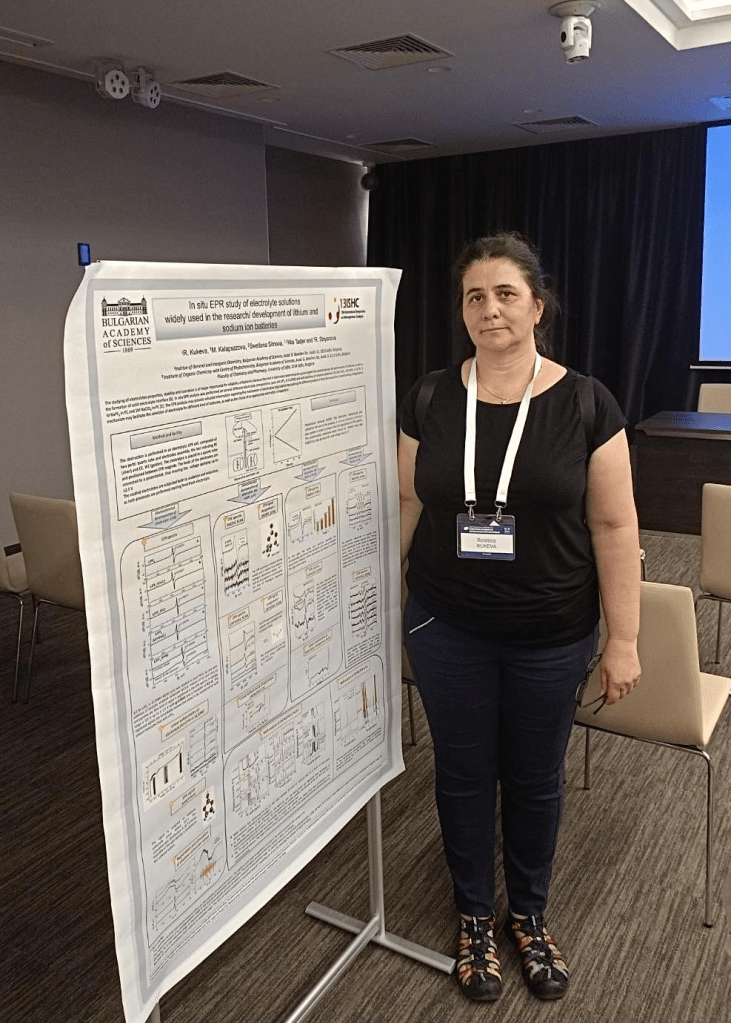
CARiM’s researcher Rositsa Kukeva had presented results and achievements on the project at an international conference “First International Conference on Electron Magnetic Resonance Applications”, 2-3 September 2024, Burgas, Bulgaria.
In situ EPR study of electrolyte solutions widely used in the research/development of lithium and sodium ion batteries
R. Kukeva, M. Kalapsazova, R. Stoyanova
Abstract: A variety of electrolytes finds application in rechargeable lithium- and sodium-ion batteries. Typically the electrolytes consist of organic solvent and lithium or sodium salt. The most ubiquitously used organic solvents are carbonates, such as ethylene carbonate, propylene carbonate (PC), dimethyl carbonate (DMC), and diethylene carbonate as major solvents, and vinylene carbonate and fluorinated ethylene carbonate as additives. Some of the electrolyte salts that find great application are NaPF6, NaClO4, NaBF4, NaTFSI, NaCF3SO3, etc. Studies of electrolytes properties, stability, and operation are of major importance for reliability of batteries because electrolyte type determines principally current density, batteries performance, as well as the formation of solid electrolyte interface [1]. In this sense, EPR analysis may provide valuable information regarding the mechanism of electrolytes degradation by studying the different products of their decomposition. Such a task requires conduction of in situ
experiments due to limited stability of degradation products in liquid media.
In situ EPR analysis was performed of several different electrolyte compositions: pure 1M LiPF6 in EC/DMC and with additives of vinylene carbonate (VC) and CeO2, 1M NaPF6 in EC/DMC, 1M NaPF6 in PC, and 1M NaClO4 in PC [2]. An electrolytic EPR cell was used for the experiments, designed for measurements of organic solutions, as device construction included golden working/counter electrode and silver electrode as reference. The principle of analysis consisted in successive applying of voltage in a determined voltage window, the last leading to electrochemical electrolyte decomposition. In parallel, EPR spectra were recorded.
The experiment thus described led to successful registration of several radical species, their assignment giving information on the pathways of radical formation. In addition to qualitative and quantitative assessment of the radicals formed, stability boundaries of the electrolytes were also investigated.
Understanding of degradation mechanism may facilitate electrolyte selection for different kind of batteries as well as the choice of an appropriate electrolyte composition.
References
1. Q. Li, J. Chen, L. Fan, X. Kong, Y. Lu, Progress in electrolytes for rechargeable Li-based batteries and beyond, Green Energy Environ., 1(1), (2016) 8–42.
2. R. Kukeva, M. Kalapsazova, H. Rasheev, G. Vassilev, A. Tadjer, R. Stoyanova, In situ electron paramagnetic resonance monitoring of predegradation radical generation in a lithium electrolyte, J. Phys. Chem. Lett., 14(43), (2023) 9633–9639.
The authors from CARiM’s Research Team are bolded.
 VIHREN-CARiM 2019