
Authors: M. Nedyalkov, E. Vassileva , P. Tzvetkov, E. Zhecheva, T. Spassov, R. Stoyanova

Abstract:
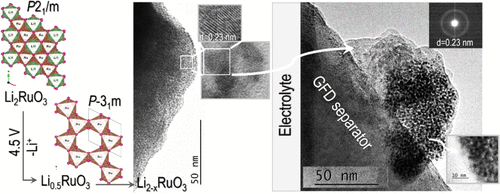
This work investigates the interplay between structural transformation, oxygen redox activity, and electrochemical pulverization that occur during lithium intercalation in monoclinic Li2RuO3 (LRO), a model layered oxide used as an oxygen-redox electrode in lithium-ion batteries. To achieve this, comprehensive studies were conducted using diffraction techniques (X-ray and electron) and microscopy methods (Scanning electron microscopy/energy dispersive X-ray spectroscopy (SEM/EDS) and Transmission electron microscopy/EDS (TEM/EDS)). A new finding is the identification of a pulverization phenomenon in LRO, occurring exclusively after the activation of oxygen redox reactions and delithiation-induced structural transformation. Upon lithium extraction up to 4.2 V (more than 75% of Li), the pristine P21/m monoclinic structure undergoes a reversible transformation into a new structural modification, namely, the P3̅1m trigonal structure. This transition is driven by the gliding of depleted Li1/3–xRu2/3O2 layers, occurring without Ru diffusion. The process induces significant lattice stress, crystallite reduction, and voltage decay, with elastic effects playing a dominant role in governing the cycling performance of the LRO at lower voltage limits. Raising the upper voltage limit to 4.5 V preserves the structural transformation but also activates lattice oxygen redox reactions, in addition to ruthenium ion redox activity. These reactions trigger multiple side interactions with the lithium electrolyte, leading to nanoscale pulverization, particularly at the particle edges. Additionally, a minor fraction (less than 1%) of the smallest particles (1–3 nm) can detach from the particle edges and migrate through the cell separator. Due to the low proportion of particle migration, the discharge capacity remains stable, while the charge capacity reaches a higher magnitude due to these transformations. The nanoscale pulverization is a rate-dependent process occurring at a high level of lithium extraction. These findings could provide critical insight into mitigating pulverization in LRO and offer ways to improve its performance as a high-voltage cathode material for lithium batteries.
 VIHREN-CARiM 2019